

Luxury
What to Know Before You Buy a Horse Property Near Houston
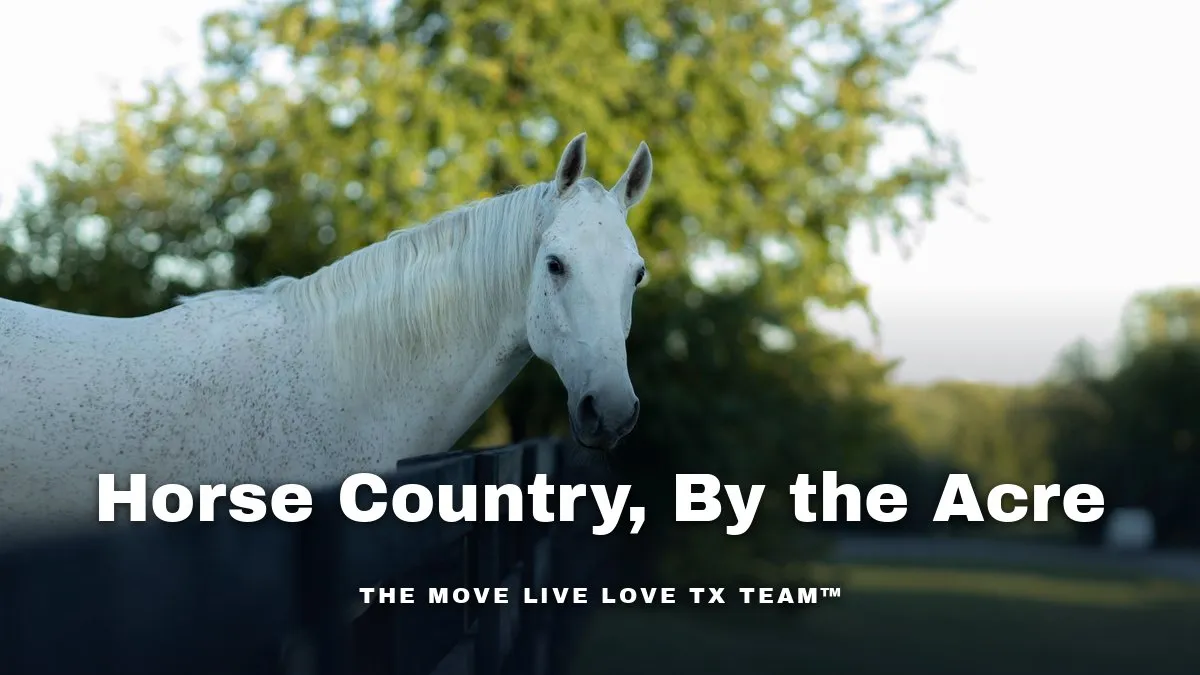
Horse properties around Hockley, Magnolia, Tomball, and Waller let you keep horses on your own land, something almost no in-town Houston neighborhood allows. But how many horses, and under what conditions, comes down to that specific subdivision’s deed restrictions, not one blanket Houston-area rule. Before you write an offer on acreage with a barn or pasture, get real answers on four things: what the deed allows, what your homeowners policy won’t cover, what the barn costs to build or finish, and whether the land can carry an agricultural tax valuation.
Acreage rules are set gate by gate, not citywide
Most of this corridor has little zoning reaching into it, so the number you’re looking for almost never comes from the county. It comes from the deed restrictions written when a developer first subdivided that tract, and those numbers move more than new buyers expect. Double Oak, north of Fort Worth, requires a full acre for the first horse and a half-acre for each additional one. Willis allows one animal on the first three acres, then one more per acre up to five. Fort Worth’s large-animal ordinance works off square footage instead, about 10,000 square feet per animal.
| Example jurisdiction | How the horse limit is set |
|---|---|
| Double Oak, TX | 1 acre for the first horse, plus 0.5 acre for each additional horse |
| Willis, TX | 1 animal on the first 3 acres, then 1 more per acre, up to 5 |
| Fort Worth, TX | About 10,000 square feet, roughly a quarter acre, per animal |
| General grazing guideline | 1.5 to 2 acres per horse, depending on pasture quality |
None of these apply automatically to a Hockley or Magnolia subdivision, and that’s the point. A few communities skip the limit entirely. Ascot Farms in Magnolia carries no HOA at all and sells lots from two to ten acres built around keeping horses. Others, including the gated acreage around Willowcreek Ranch near Tomball, set their own number in the covenants. Pull the real CCRs on a property before the option period starts, not after, and don’t carry a number over from a different subdivision or a different county.
Homeowners insurance usually ends at the pasture fence
A standard Texas homeowners policy is written around the house, the garage, and the people living inside them. It generally excludes liability connected to horses, and many policies cap or exclude coverage on barns and other outbuildings outright. If a boarder, a farrier, or a neighbor’s kid gets hurt around your horses, the homeowners carrier can deny the claim entirely. Most owners add one of two things: a personal horse owner liability policy, which runs roughly $150 to $400 a year and covers you on and off the property, at shows, on trail rides, anywhere the horse travels, or a full farm and ranch policy that also covers the barn structure, equipment, and any boarding or training activity. If you plan to board other people’s horses or run lessons, you need Care, Custody, and Control coverage specifically, since a standard liability policy won’t pay to replace a horse that isn’t yours.
A barn’s real cost, and why the mortgage may not match it
A custom horse barn in the Houston area runs $35 to $85 per square foot in 2026, depending on whether it’s a metal pole barn or a timber-frame center-aisle design with a tack room and wash bay. A basic four-stall barn with those finishes typically costs $90,000 to $145,000, and an attached covered arena adds another $18 to $30 per square foot on top of that.
Peter came up through construction and mortgage lending before real estate, and the lending side matters here as much as the construction side. Appraisers and lenders often treat a barn or arena as a limited-value improvement rather than square footage that adds dollar for dollar to the appraised value, which means a buyer financing a $150,000 barn build alongside the home purchase can end up carrying more of that cost out of pocket than planned. That’s a conversation to have with the lender before the contract, not after the barn is framed.
The tax exemption depends on what the horses are doing
Owning horses doesn’t by itself qualify acreage for an agricultural tax exemption in Texas. The horses have to be part of a genuine agricultural operation, breeding or training, for example, not kept purely for personal riding, and the county appraisal district can and does check. Most Houston-area counties also expect real acreage under that use, generally in the 10 to 15 acre range, before an application has a real shot. We cover this in full, including the wildlife exemption option and the rollback tax risk that catches new buyers off guard, in our wildlife and ag exemption guide.
Water matters here too. A barn and pasture need a reliable supply well beyond what a house alone uses, and most of these properties run on private wells rather than a municipal line. Our well and septic guide covers what to test before the option period ends, and the same questions apply to a well that also has to supply a barn and water troughs.
None of this should talk a serious buyer out of acreage with a barn on it. The land northwest of Houston, in Hockley, Magnolia, Tomball, and Waller, is some of the best left within reasonable commuting distance of the city, and the lifestyle it supports is the whole reason people go looking for it in the first place. It means the diligence list runs longer than a standard home purchase, the deed restrictions, the insurance, the barn’s real cost, and the tax status all need an answer before the option period clock is already running. The Move Live Love TX Team™, led by Peter and Vicky Royster, works with buyers across Houston and the surrounding areas who want land to go with the house, and Peter’s Certified Luxury Home Marketing Specialist designation and construction background mean the barn and the fencing get the same scrutiny as the kitchen. Our Navigating Luxury Real Estate guide covers the rest of what makes a high-end purchase different from a standard one.
Frequently Asked Questions
- How many acres do you need to keep a horse on a property near Houston?
- Acreage limits for a horse near Houston come from the specific subdivision's deed restrictions or a city's own ordinance, not one areawide rule, ranging from one horse per half-acre in some towns to one horse per three acres in others. Always check the actual deed before assuming a number.
- Does a standard homeowners insurance policy cover horses and a barn?
- A standard homeowners policy usually excludes liability tied to horses and often limits coverage on barns and other outbuildings, so most owners add a separate farm and ranch policy or a dedicated equine liability policy on top of it. Personal horse owner liability coverage alone can start around $150 to $400 a year.
- How much does it cost to build a horse barn near Houston in 2026?
- A custom horse barn in the Houston area typically runs $35 to $85 per square foot depending on materials and finish, so a basic four-stall barn with a tack room and wash bay often lands between $90,000 and $145,000, before an attached covered arena.
- Can you get an agricultural tax exemption for keeping horses alone?
- Only if the horses are part of a genuine agricultural operation such as breeding or training, not kept for personal recreation, and most Houston-area counties also expect real acreage under that use, generally in the 10 to 15 acre range, before an application has a real shot at approval.
- Which Houston-area communities allow horses on the property?
- Several deed-restricted subdivisions northwest of Houston, in and around Hockley, Magnolia, Tomball, and Waller, are platted specifically for horses, and some carry no HOA at all, unlike most in-town Houston neighborhoods where horses aren't allowed regardless of lot size.